


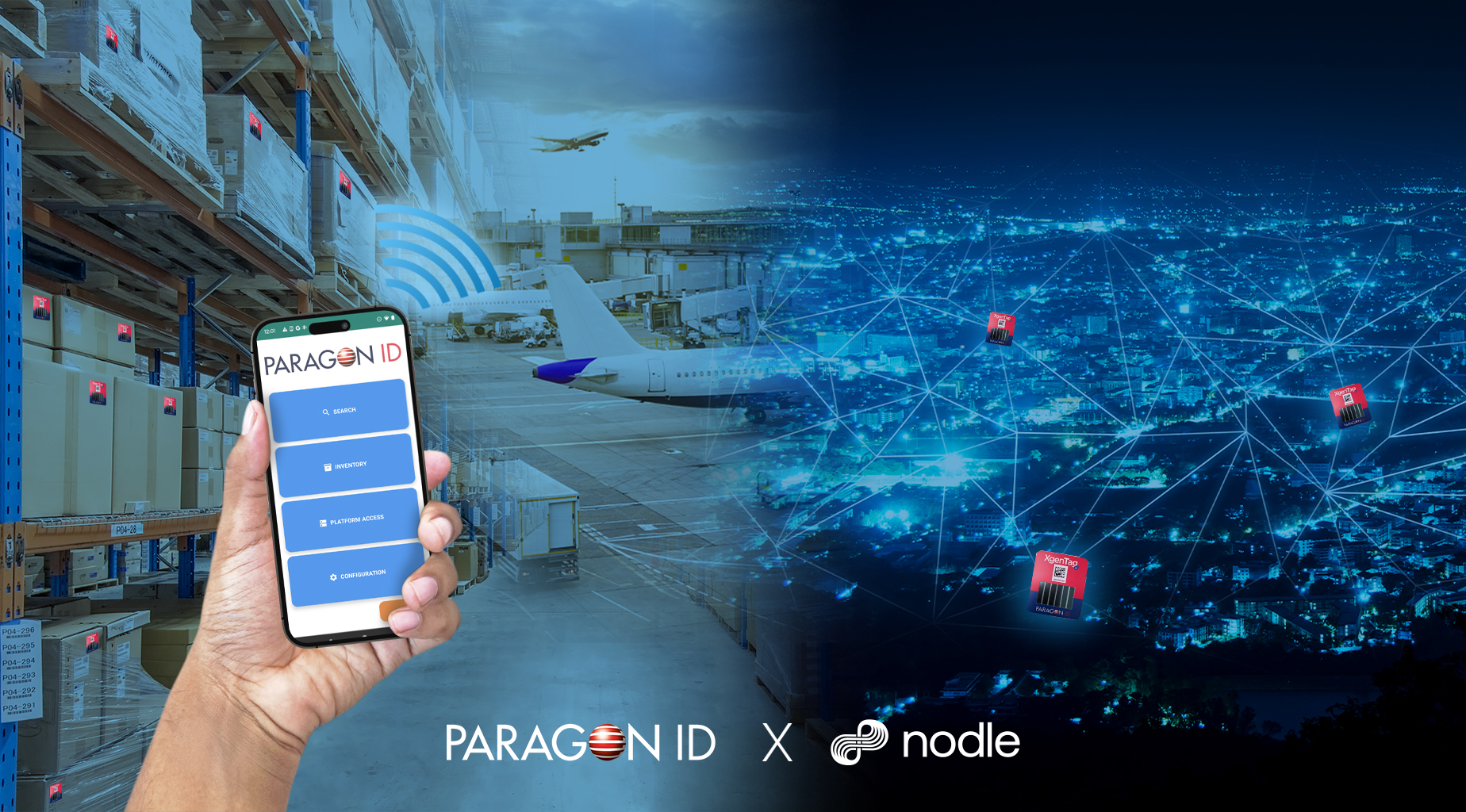
Nodle is applying the power and flexibility of software to leverage the existing smartphone infrastructure and build a fully decentralized wireless network. Combined with the latest innovation from Paragon ID with its battery free BLE tag it not only optimizes costs by removing the need for RFID readers but it also opens up access to new use cases that were not possible before and grows the addressable market for both organizations.
The collaboration between Nodle and Paragon ID marks a genuine inflection point in how the physical world gets tracked and understood.
Paragon-ID's XgenTag devices are battery-free Bluetooth Low Energy tags that harvest energy from ambient light or RFID fields. They broadcast continuously, require zero maintenance, and can operate for over a decade. Nodle turns the billions of smartphones already in people's pockets into a global, decentralized connectivity layer that captures those signals and relays them to the cloud.
The result: asset tracking with no readers, no gateways, no batteries—just software running on devices that already exist.
For decades, deploying asset tracking meant significant upfront investment: fixed readers, dedicated networks, cellular contracts, and battery replacement cycles. This made large-scale tracking economically viable only for high-value assets.
That constraint is now dissolving.
When you reuse an existing global network instead of building a new one, the cost structure shifts from capital expenditure to near-zero marginal cost. Tracking stops being limited by infrastructure. It scales with software.
When cost and complexity collapse, the addressable market expands dramatically.
Battery-free tags and a decentralized network make tracking viable for categories that traditional systems couldn't serve economically:
These are all contexts where assets cross boundaries: between facilities, between operators, between indoor and outdoor environments. The critical breakthrough here isn't just lower cost — it's seamless handoff. A single system that works inside a warehouse and out in the open world, without changing hardware or technology.
What makes this moment distinctive isn't better hardware alone. It's the application of a principle that already transformed computing and telecom: replace fixed infrastructure with programmable, distributed systems.
Nodle deploys software missions to smartphones instead of installing physical readers. The network is global by default, elastic in coverage, and continuously improves as participation grows. And because users are rewarded for contributing connectivity, the incentive structure is built in.
This is what a software-defined physical network looks like in practice.
The compounding effects are significant:
What used to require a dedicated business case becomes a default operational capability. The market doesn't just grow — it shifts. From millions of tracked assets to potentially billions.
We are building toward a world where every object can broadcast its presence, every smartphone can act as a node, and every interaction generates useful data — not through centralized infrastructure, but through a shared, decentralized fabric.
That foundation enables what comes next: real-time supply chain intelligence, verified physical-digital twins, autonomous logistics, and sensor-rich environments that can actually be trusted.
The convergence of energy harvesting, Bluetooth sensing, and decentralized connectivity is rewriting the constraints that shaped IoT for the past two decades. When hardware no longer needs power and networks no longer need infrastructure, an entirely new design space opens up.


